


Label Guide: Island
Island Records was founded by Chris Blackwell and Graeme Goodall in 1959 in Jamaica. The company relocated to the UK in 1962 and its early focus was on Jamaican reggae music before the label became a major player in the progressive rock scene of the late 1960s.
When Chris Blackwell decided in 1967 to diversify the label into new British rock music, he scored an immediate success by signing Art (later Spooky Tooth) and Traffic. Soon the label was the home for some of the best-selling British progressive acts as Jethro Tull, Emerson Lake & Palmer, King Crimson, and Free. This highly influential and successful era culmitates in the 'pink Island' years from 1967 to 1975.
Island also did groundbreaking work with psychedelic folk-rock acts like Fairport Convention and Nick Drake, spearheaded by Chris Blackwell's personal friendship with American producer Joe Boyd. Singer-Songwriters as Cat Stevens and John Martyn added to the label's success in the acoustic field.
In the mid-1970s Island became the world's top reggae label with artists like Bob Marley, Steel Pulse and Toots & The Maytals on its roster. Bob Marley became the label's best-selling act.
In July 1989, Blackwell sold the label to PolyGram and Island was no longer an independent company. In 1998 all of the Polygram and associated labels were purchased by Seagrams, and Island Records is now a subsidiary of Universal Music Group.
-
1. Label Variation
 first Island label (1962 - 1966)
This is the first Island label in the UK, used for the early releases until ILP 951 (1967) when the "pink era" started.
first Island label (1962 - 1966)
This is the first Island label in the UK, used for the early releases until ILP 951 (1967) when the "pink era" started.
-
2. Label Variation
first pink Island label (1967 - Summer 1969)
This is the first Island label with a bright pink design, often referred to as the 'Pink Eye Label' or 'Eyeball Label'. The first album with this label was John Martyn's London Conversation (1967), and the last one Dr. Strangely Strange's Kip Of The Serenes (ILPS 9106, 1969). In the summer of 1969 Island started to use alternative label designs, however not chronologically. But all ILPS releases earlier than the Dr. Strangely Strange album, with the exception of ILPS 9100, ILPS 9102, ILPS 9104 and ILPS 9105 have been originally issued with this Eyeball label.
-
3. Label Variation
 second pink Island label (Sep 1969 - Dec 1969)
This very short-lived second label variation was only used through the second half of 1969. It is usually called the 'Black Block Label'. Only three Island albums have been originally released with this label: Clouds' Scrapbook, Fairport Convention's Unhalfbricking and Nick Drake's Five Leaves Left, but there are several reprints of earlier releases that carry this label design.
second pink Island label (Sep 1969 - Dec 1969)
This very short-lived second label variation was only used through the second half of 1969. It is usually called the 'Black Block Label'. Only three Island albums have been originally released with this label: Clouds' Scrapbook, Fairport Convention's Unhalfbricking and Nick Drake's Five Leaves Left, but there are several reprints of earlier releases that carry this label design.
-
4. Label Variation
 third pink Island label (Summer 1969 - late 1970)
This third pink Island label was introduced in 1969 with the self-titled album of the band Free. It is usually referred to as the 'White "i" Label'. Island used both this label and the 'Black Block' label in the second half of 1969, there is no clear order for these releases.
third pink Island label (Summer 1969 - late 1970)
This third pink Island label was introduced in 1969 with the self-titled album of the band Free. It is usually referred to as the 'White "i" Label'. Island used both this label and the 'Black Block' label in the second half of 1969, there is no clear order for these releases.
-
5. Label Variation
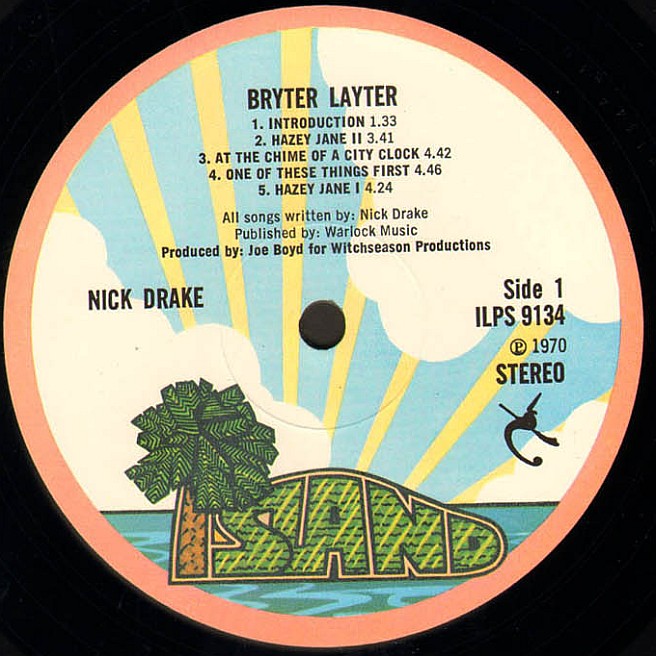 fourth pink Island label (late 1970 - 1975)
This fourth label variation is often called 'Pink Rim' or 'Palm Tree' label. It was in use for about five years and does no longer belong to the core 'pink island' labels as referred to by collectors. However, many of these pink rim releases are highly collectible, such as the final two Nick Drake albums.
fourth pink Island label (late 1970 - 1975)
This fourth label variation is often called 'Pink Rim' or 'Palm Tree' label. It was in use for about five years and does no longer belong to the core 'pink island' labels as referred to by collectors. However, many of these pink rim releases are highly collectible, such as the final two Nick Drake albums.
-
6. Label Variation
 fifth pink Island label (early 1970s)
This variation, showing a Pink 'I' on a black background was used for special series in the early Seventies.
fifth pink Island label (early 1970s)
This variation, showing a Pink 'I' on a black background was used for special series in the early Seventies.
-
7. Label Variation
 UK Palm Tree Island label (late 1970s)
This design was used from about 1976.
UK Palm Tree Island label (late 1970s)
This design was used from about 1976.
-
8. Label Variation
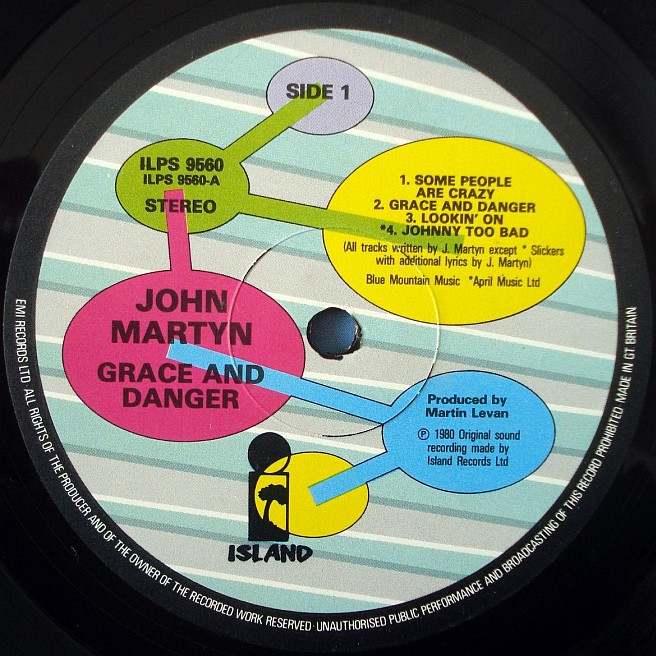 UK Bubbles Island label (late 1970s/early 1980s)
This crazy label design was used for a short period around the turn of the decade into the 1980s.
UK Bubbles Island label (late 1970s/early 1980s)
This crazy label design was used for a short period around the turn of the decade into the 1980s.
-
9. Label Variation (Side One)
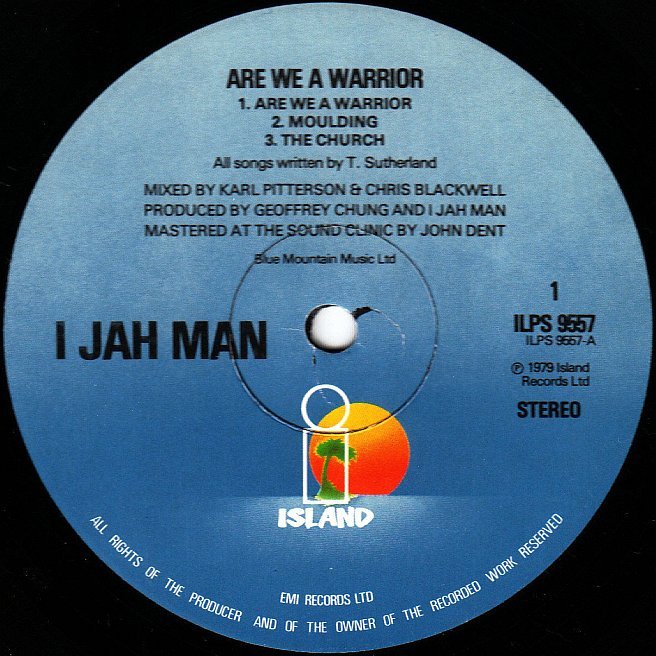 ninth UK Island label, Side One (late 1970s/early 1980s)
Introduced in 1977 and used well into the 1980s. Designs might have been overlapping in the late 1970s.
ninth UK Island label, Side One (late 1970s/early 1980s)
Introduced in 1977 and used well into the 1980s. Designs might have been overlapping in the late 1970s.
-
9. Label Variation (Side Two)
 ninth UK Island label, Side Two (late 1970s/early 1980s)
Two different Island logos, one for each side, were used with this label variation.
ninth UK Island label, Side Two (late 1970s/early 1980s)
Two different Island logos, one for each side, were used with this label variation.
-
10. Label Variation
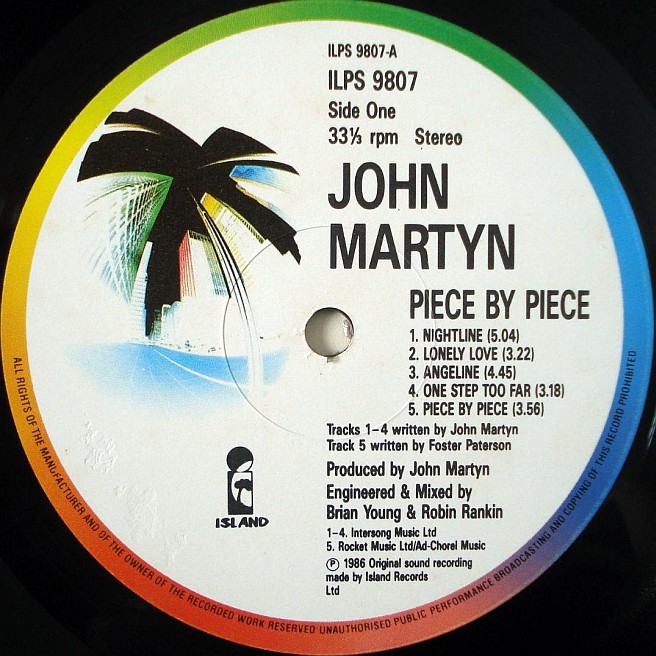 UK Eighties Island label (1980s)
This standard UK Island label of the 1980s with a 'Palm Tree' image and a rainbow rim.
UK Eighties Island label (1980s)
This standard UK Island label of the 1980s with a 'Palm Tree' image and a rainbow rim.
-
11. Label Variation
 UK Nineties Island label (1990s)
The 'i' symbol was dropped in the early 1990s, here an example from 1993.
UK Nineties Island label (1990s)
The 'i' symbol was dropped in the early 1990s, here an example from 1993.
-
1. US Label Variation
 U.S. Island label (1973)
An early version of the U.S. Island label shows the familiar 'I' logo filled with the palm tree image.
U.S. Island label (1973)
An early version of the U.S. Island label shows the familiar 'I' logo filled with the palm tree image.
-
2. US Label Variation
 U.S. Island label (1974)
This unique and very colourful holiday-style label was used for many U.S. releases in the early 1970s.
U.S. Island label (1974)
This unique and very colourful holiday-style label was used for many U.S. releases in the early 1970s.
-
3. US Label Variation
 U.S. Island label (1980s)
The U.S. Island label of the 1980s with another unique design, a scripted logo with what looks like a skyscaper on a purple background, almost entirely abandoning the Caribbean feel of all previous label designs.
U.S. Island label (1980s)
The U.S. Island label of the 1980s with another unique design, a scripted logo with what looks like a skyscaper on a purple background, almost entirely abandoning the Caribbean feel of all previous label designs.
-
4. US Label Variation
 U.S. Island label (1987)
This is a version of the late 1980s U.S. label, here 1987.
U.S. Island label (1987)
This is a version of the late 1980s U.S. label, here 1987.