
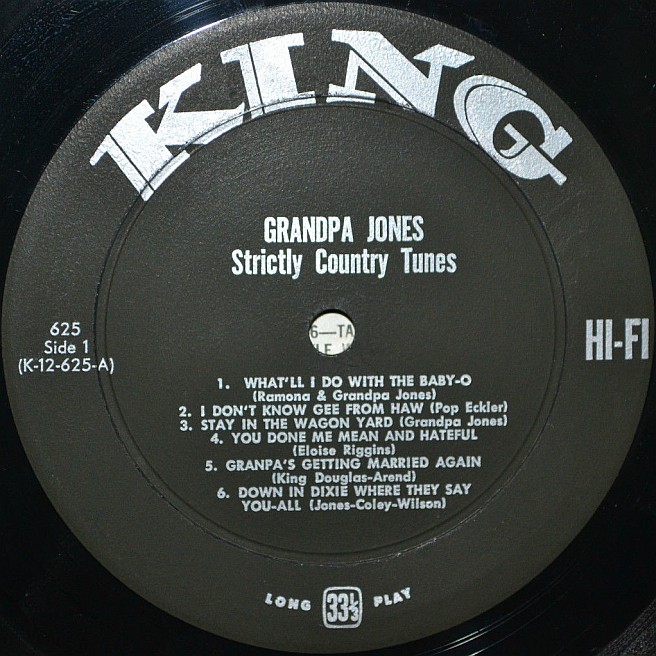


Label Guide: King
King Records was started in 1943 by Syd Nathan and originally headquartered in Cincinnati, Ohio. At first it specialized in country music, at the time still known as "hillbilly music." King advertised, "If it's a King, It's a Hillbilly - If it's a Hillbilly, it's a King." King started several sub-labels early in its history, including Queen Records, at the time cllaed a "race records" (African American) label, which was merged with the King label within a year or two, and most notably Federal Records, founded in 1950, which launched the career of James Brown.
In the 1950s, R&B and soul music replaced country music as the dominant force in King's business. King Records was highly successful with R&B artists like Joe Tex, Roy Brown, Jack Dupree, Otis Williams & The Charms, Hank Ballard & The Midnighters, Ivory Joe Hunter and Johnny Guitar Watson. King also bought out several other record labels, including De Luxe Records (in 1952), and Bethlehem Records.
When Syd Nathan died in 1968, King Records was acquired by Hal Neely's Starday Records and relaunched as 'Starday and King Records'. The legendary songwriting duo Leiber & Stoller bought the label in 1970, but sold it soon afterwards to LIN Broadcasting which in turn sold it to Tennessee Recording & Publishing, who sold it in 1974 to Gusto Records. King Records is now only used as a record label under the parent company, Gusto Records.
-
78rpm Label Variation (I)
 78rpm King label (early 1950s)
The 78rpm shellac label came in a red and a blue version.
78rpm King label (early 1950s)
The 78rpm shellac label came in a red and a blue version.
-
78rpm Label Variation (II)
 78rpm King label (early 1950s)
The 78rpm shellac label came in a red and a blue version.
78rpm King label (early 1950s)
The 78rpm shellac label came in a red and a blue version.
-
2. Label Variation
 second King label (1952 - 1955)
The red label of the early 1950s for both the 10" releases and the classical music series. There were different shades of red and also minor variations of the label text over these years.
second King label (1952 - 1955)
The red label of the early 1950s for both the 10" releases and the classical music series. There were different shades of red and also minor variations of the label text over these years.
-
3. Label Variation (Mono)
 third King label, mono (1956 - early 1960s)
The first of the black labels had a small KING logo at the top. It was used from the beginning of King's regular LP releases, catalogue numbers 395-500/500 and higher, in 1956.
third King label, mono (1956 - early 1960s)
The first of the black labels had a small KING logo at the top. It was used from the beginning of King's regular LP releases, catalogue numbers 395-500/500 and higher, in 1956.
-
3. Label Variation (Stereo)
 third King label, stereo (1956 - early 1960s)
The labels for stereo albums had a blue background.
third King label, stereo (1956 - early 1960s)
The labels for stereo albums had a blue background.
-
4. Label Variation (Mono)
fourth King label, mono (early 1960s - 1966)
The second version of the black labels has a large KING logo at the top. In print until 1966.
-
4. Label Variation (Stereo)
 fourth King label, stereo (early 1960s - 1966)
The second version of the black labels has a large KING logo at the top. In print until 1966.
fourth King label, stereo (early 1960s - 1966)
The second version of the black labels has a large KING logo at the top. In print until 1966.
-
5. Label Variation (Mono)
 fifth King label, mono (1966 - 1970)
In 1966, King Records redesigned the logo to include a crown on top of the straight 'KING' text. Mono labels continued to be black.
fifth King label, mono (1966 - 1970)
In 1966, King Records redesigned the logo to include a crown on top of the straight 'KING' text. Mono labels continued to be black.
-
5. Label Variation (Stereo, I)
 fifth King label, stereo (1966 - 1970)
There are now blue and red versions for stereo labels. The blue label also comes in (at least) two different versions.
fifth King label, stereo (1966 - 1970)
There are now blue and red versions for stereo labels. The blue label also comes in (at least) two different versions.
-
5. Label Variation (Stereo, II)
 fifth King label, stereo (1966 - 1970)
There are now blue and red versions for stereo labels. The blue label also comes in (at least) two different versions.
fifth King label, stereo (1966 - 1970)
There are now blue and red versions for stereo labels. The blue label also comes in (at least) two different versions.
-
5. Label Variation (Stereo, III)
 fifth King label, stereo (1966 - 1970)
There are now blue and red versions for stereo labels. The blue label also comes in (at least) two different versions.
fifth King label, stereo (1966 - 1970)
There are now blue and red versions for stereo labels. The blue label also comes in (at least) two different versions.
-
6. Label Variation (James Brown)
 sixth King label, James Brown (1969 - 1970)
A special label was introduced in 1969 to be used with James Brown albums and those that he produced. The first album with this custom design was by Hank Ballard, KSD 1052.
sixth King label, James Brown (1969 - 1970)
A special label was introduced in 1969 to be used with James Brown albums and those that he produced. The first album with this custom design was by Hank Ballard, KSD 1052.
-
7. Label Variation (James Brown, I)
 seventh King label, James Brown (1970 - 1971)
The custom James Brown related label changed to this design in late 1970.
seventh King label, James Brown (1970 - 1971)
The custom James Brown related label changed to this design in late 1970.
-
7. Label Variation (James Brown, II)
 seventh King label, James Brown (1970 - 1971)
The custom James Brown related label changed to this design in late 1970.
seventh King label, James Brown (1970 - 1971)
The custom James Brown related label changed to this design in late 1970.
-
8. Label Variation
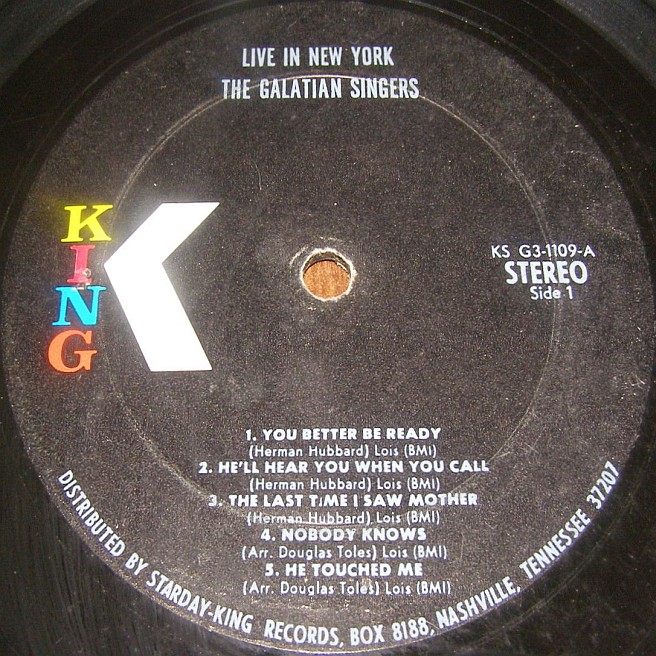 seventh King label, regular albums (1970 - 1971)
The regular King label changed to this second James Brown design in late 1970, omitting only Brown's face. Used from KS 1101 to about KS 1136.
seventh King label, regular albums (1970 - 1971)
The regular King label changed to this second James Brown design in late 1970, omitting only Brown's face. Used from KS 1101 to about KS 1136.
-
9. Label Variation
 eighth King label (1972 - 1973)
The final King label was used for the last few albums, starting with KS 1139 in 1972.
eighth King label (1972 - 1973)
The final King label was used for the last few albums, starting with KS 1139 in 1972.